When will my baby get his first tooth?

babytooth

Baby teeth or primary teeth are playing a very important role in a child’s life. They are vital for chewing and speech development and in maintaining the space for the adult teeth. For this reason, your child should be taught how to have a good dental hygiene from a very young age.

Normally, your children will have their first teeth around six months old. Sometimes maybe earlier as four months and as late as ten. No need to alarm if teething starts a little earlier or later. If you’re worried, see a dentist to make sure everything is as it should be. There are 20 baby teeth, ten at the top and ten at the bottom. Usually they erupt in pairs from the front of the mouth to the back. The bottom ones are arriving a couple of months prior to the top ones.

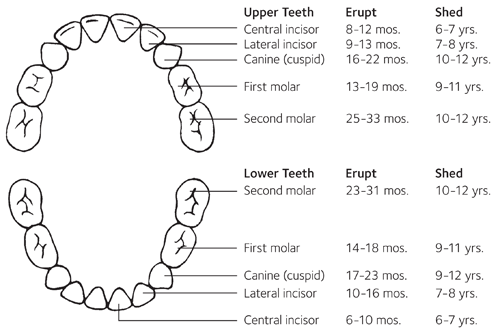
The ADA chart below illustrates the names of each tooth, at what age it is likely to erupt, and at what age they are then likely to be lost.
babytooth2

  • Lower central incisors, the bottom middle teeth, typically come in first. These little ones usually arrive around the same time.
  • Upper central incisors, the upper middle teeth, come next, usually between 8 and 12 months.
  • Upper lateral incisors, around 9 to 13 months you can see the upper teeth to the right and left of center.
  • Lower lateral incisors, the lower teeth to the right and left of center appear around 10 to 16 months. Now your baby can have the toothy smile.
  • Upper first molars – your child’s first molars, the wider teeth toward the back of the mouth, erupt on the top between about 13 and 19 months.
  • Lower first molars, the companion molars on the bottom emerge around 14 to 18 months.
  • Upper canines fill the gap between the incisors and first molars at 16 to 22 months.
  • Lower canines make their appearance around 17 to 23 months. Your child’s smile is the brightest.
  • The second molars, around 23 to 33 months, the final teeth, the rear molars on the bottom and top, emerge.

By age 3, most children have a full set of 20 baby teeth and can give you a brilliant smile. And by around age six a child will start losing them to make way for their adult teeth.

For your children first dental visit please contact us on 02 8021 5285
How To Brush Your Child’s Teeth

brush childs teeth

child has a full set of 20 baby teeth by the age of two to three years.

As soon as your baby develops their first tooth, they are at risk of dental decay. To prevent this, firstly you should make sure you clean your child’s teeth morning and night and maintain a good oral hygiene by brushing and flossing their teeth and having regular dental check-ups, apart from choosing a healthy diet and proper overall hygiene.

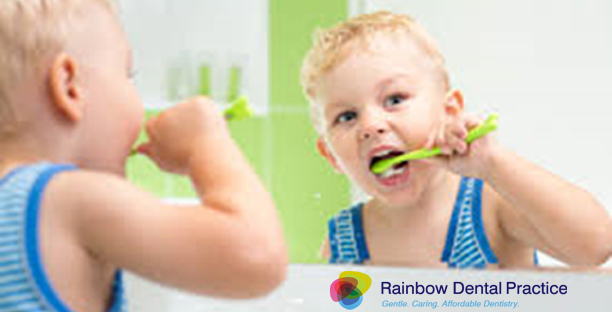
To brush your baby’s teeth, use a baby’s toothbrush with a small head and soft with rounded bristles. Replace the toothbrush regularly, in between one to three months. Having your baby on your lap, facing away from you, helps you reach the teeth more easily. Brush with small, gentle circular movements, concentrating on the area where the teeth and gums meet. If your baby doesn’t like having the teeth brushed and squirms away, try giving them their own toothbrush to hold. It is very probable that they will feel in charge. You can even let them to have a go by themselves. Of course, with your help. Up to 18 months, brush their teeth with plain water. Special fluoride-free toothpastes can be used around the age of 18 months. Just a very small amount.

Teach your child to spit out the toothpaste after brushing. But don’t rinse his mouth with lots of water. Leaving a bit of toothpaste residue on the teeth makes the toothpaste work better. Do not forget to put the toothpaste out of reach of the children because some of them like it too much and they can eat it.

If you can, let your baby watch you brushing your teeth as often as possible. The power of example! You also can seek guidance to your dentist or dental hygienist. They will be happy to help.

Toddlers should have their teeth brushed twice a day, ideally for two minutes at a time, in the morning after breakfast and in the evening before bed. Your toddler will need your attention during brushing.

Teach them how to brush. Don’t forget to get the right brush, with a long handle that allows you to reach around every tooth in your toddler mouth. Sometimes, you can apply the finger brushing. Finger toothbrushes slip onto your finger and have soft bristles at the tip. Buy a colourful toothbrush. You can find a toothbrush that lights up, plays music, or makes a noise after the job’s done. Whatever type of toothbrush you use, replace it every one to three months.

Put your child on a step stool in front of you. Face a mirror and brush his teeth with your hand over their hand. This way, they can watch you and learn how to brush. Work on one tooth at a time, and use a gentle back-and-forth motion across the chewing and inner surfaces, then switch to a circular motion along the sides, holding the brush at a 45-degree angle. On areas that don’t have teeth yet, lightly brush the gums, and don’t forget the tongue, which is a popular hangout for bacteria.

Regarding the toothpaste and mouthwash, it is better to stick only to water or fluoride-free toothpaste until your child can be trusted not to swallow it. After that, your child can start using a pea-sized amount of fluoridated toothpaste. When they are around two years old, you can show them how to rinse after brushing. You can also use a fluoride-free mouthwash, if the dentist or paediatrician gives you the ok.

Flossing is needed to be started as soon as two teeth grow in side by side. Starting with the age of two and a half, you can floss at least twice weekly in areas where the teeth are touching. Flossing helps remove bacteria from between teeth and keeps the gums healthy. You can use your regular floss or try one of those handheld plastic flossers shaped like a kid-friendly character.

Have your toddler on your lap, facing you. Floss their teeth as you would your own, using your index fingers and thumbs to guide floss gently in between the teeth. Carefully slide the floss up and down against the tooth surface and under the gum line, flossing each tooth with a clean section. Focus on the molars first and work your way from the back of the mouth to the front. You may let your little one have a go with the floss. After flossing, have your child rinse with water. And finally, brush your child’s teeth.

Try to make your children’s cleaning teeth a fun time! You may sing a song, tell a story or ask a nightly riddle during brushing.

Giving them a good hygiene and a proper health education is the foundation of a healthy and happy life!

Please feel free to contact our kids friendly dentist on 02 8021 5285 if you have any queries.

School Holidays And … A Visit To The Dentist

Taking advantage of Medicare Child Dental Benefits Scheme

child-dental-benefits

School holidays are approaching!

Try to benefit from this time of year and book your children in for their regular dental check-up or any other needed treatment, by using your private health dental benefits or the Medicare’s Child Dental Benefit Scheme.

Good oral health is an important “pillar” of a good overall health. A dental check-up will provide a great start to dental health for you and your children.

According to prof. David Manton, the Chair of the Australian Dental Association’s (ADA) Oral Health Committee, there are lots of evidences suggesting that the oral health of Australian children is not at the level that should be, having over 4 out of 10 children aged 5-10 with decay in their baby teeth; more than 3 out of 10 children aged 9-14 having decay in their permanent teeth and over 4 out of 10 children overall had moderate or abundant visible plaque on their teeth. With these, the Professor Manton is accentuating the need and the importance for a regular dental check-up.

In accordance with statistical studies, children under the age of 10 are best treated in the morning, when they are fresh and rested, rather than in the afternoon, when they might be tired after school and the treatment could be more stressful for them and their parents. Parents may have some concerns about taking the children out of school for their dental appointments. One of the best solutions is to arrange an appointment to see the dentist during school holiday periods.

The teenagers can be seen in the afternoons, because they are more relaxed at 2pm rather than 3.30pm or later. But they may still have school at that time of the day. Sometimes it is easier to remove them from school for the last one or two lessons than taking them out of school and returning after, especially if they may have a numb jaw after fillings or extraction treatments. Again, the best solution is to have them booked at the dentist during their school holidays.

Pre-booking your child for the next visit in 6 months for a regular check-up gives parents a greater flexibility in selecting the best times that suit their children’s ages and school requirements. Also, you could wisely use the benefits for dental treatments from your health private funds.

If you have not known, maybe you should consider to check if your child is eligible for the Australian Government’s Child Dental Benefits Schedule (CDBS) and having basic dental treatments covered by Medicare. This service is designed to provide financial support for children between the ages 2-17 years of age, allocating $1000 every two years for basic dental services, per child. Prior to book an appointment at the dentist, check with Medicare to see if they are eligible. Under this scheme, children can receive treatment from either a public or private dental clinic. You should let the dentist know, when you are booking, that you are looking to take advantage of this scheme. At the time of appointment, you will need to have a current Medicare card and fill in a “CDBS bulk billing consent form”.

Basic dental services covered by the scheme are: examinations, X-Rays, cleaning, fissure sealing, fillings, root canal treatment, some extractions.

Please note that services including orthodontic or cosmetic dental work are not covered by the Child Dental Benefits Schedule.

For more information on eligibility please call us on 02 8021 5285 we will check your children eligibility and let you know.

Dental Trauma and First Aid

dental trauma

Some injuries on head area can be quite serious and have consequences for your oral health. The most common causes of dental injuries are falling over, being hit in the face or having an accident while playing sport. Also, it is possible to injure or break a tooth by biting something hard. An injury to your teeth or mouth may cause bleeding or swelling. You may also have a loose, cracked, broken or knocked out tooth or damage to your tooth’s roots.

With prevention, some trauma of dental injury can be minimised and knowing how to react in these situations you could be spared from a lot of trouble, physically and money wise.

If you play sports, it is a very good idea to wear a custom-made mouthguard to minimise the chance of any damage. Ask your dentist about the right type of oral protection for yourself or your child.

In cases of dental trauma, contact your dentist immediately to assist you. You also should ask specific advice on how to handle the dental emergency.

In some cases, after an accident, teeth can be cracked, chipped or become loose without being easily detected. Failure to get them checked out in time by your dentist may mean sustaining a problem that otherwise could have been avoided.

Before you reach the dentist, you may have to follow some steps to minimise the damage.

  • Get to your dentist as quickly as possible, ideally within 30 minutes in case a tooth was knocked out.
  • Find and clean the tooth holding it only by the crown. Do not touch the root.
  • If the tooth is dirty, rinse it in milk, but don’t scrub or soak it. If milk is not available, use saliva or a sterile saline solution (available from pharmacies).
  • Place the tooth back in position, making sure it is well fitted in the socket. For children, if it is a baby tooth, don’t put it back in. The dentist will not try to put it back in. They will leave the space until a new, permanent tooth grows.
  • Bite gently on soft cloth or tissue, or your mouthguard to hold the tooth in place. If you cannot replant the tooth, transport it in milk, saliva or sterile saline solution if milk is not available. Otherwise, you should put the tooth very carefully in your mouth between your cheek and gum and go to the dentist. Be very careful not to swallow it. You can also use plastic wrap to protect the tooth. Use some saliva on it before wrapping the tooth.
  • If the tooth is broken, the broken pieces should be placed in milk or a sterile saline solution and taken to the dentist.
  • If you have swelling, use a cold compress against the side of your face to relieve pain and reduce the swelling.
  • If a toothache is developed, book an appointment with your dentist straight away. In the meanwhile, rinse your mouth with salt water, use paracetamol to manage the pain and, if there is any swelling, use a cold compress.
  • If you have a bleeding after your dental injury, apply pressure over the area with a clean cotton handkerchief, slightly dampened with clean water. Keep it in place for 15 minutes without removing it.
  • Check to see if the bleeding has stopped. If not, repeat the process and keep the gauze in place until you are seen by the dentist.
  • If you are in pain, get advice on pain relief medicines you could take.
  • If your braces, retainers or other appliances are broken or damaged, you shouldn’t wear them until they have been checked and adjusted by their orthodontist.

For emergency dental appointments please call us on 02 8021 5285.

About Mouth Guards

Mouth Guards

Aussies looooooves playing sports!

No matter if the sport is contact or not, injuries may occur though and sometime very serious dental injuries, which are often difficult to treat, expensive and requiring an extensive treatment.

Prevention is always better than the cure. So, play it safe … and wear a mouth guard!

The Australian Dental Association recommends a customised mouth guard for everyone participating in contact sport or sports with high risk of dental injury.

A mouth guard, in general, is covering the upper teeth and, in the same time, is protecting the soft tissues of your tongue, lips and cheek lining. It can be used either as a protective device to prevent dental injury during contact sports or as a dental appliance to treat bruxism (teeth clenching or grinding) or TMJ/TMD (Temporomandibular Joints/ Disorder).

The customised kind of mouth guard, especially designed by your dentist, is more comfortable for breathing and speaking. The other type of mouth guards is the kind you can buy from pharmacy or sports store. They are called ‘boil and bite’. The inconvenience is that they offer less protection as they are not perfectly fitted on your teeth and may be loose in the mouth, which could be dangerous during impact.

If you are opting for a customised mouth guard, which is the best option for you, your dentist will take an impression and will use the model for an accurately and uniquely designed mouth guard. Once your mouth guard is fitted your dentist will advise you how to use it and take care of it properly. This mouth guard may need to be replaced if it has been damaged, worn out or if you have new teeth since your mouth guard was first fitted. When you are going for the regular check-up at the dentist, bring with you your mouth guard to be assessed by your dentist.

To keep your mouth guard in perfect condition, you should protect them from the direct action of the sun or any other source of heat, store them in a cool place inside the plastic container with vents that allow air to circulate and have your dentist to evaluate it at your regular check-ups. After use, rinse it with lurk water and allow it to air-dry. Occasionally, use a mouthwash to disinfect it.

Please feel free to contact our dentists on 02 8021 5285 and have a chat with them about your best option.

Don’t Lose Your Dental Benefits!!!

dental benefits 2016

The end of the year is almost here!!!

Do you know that your private health insurance dental benefits for the year are about to expire?

Normally, the private health funds do not allow to rollover your benefits – so if you haven’t already used them, you will lose them!

For these benefits, you have already paid for through your monthly or yearly premiums for private health, and of course you are entitled to. Why not make the most out of them and use them before they expire?

One of the most important treatments and the least “tormenting” is a normal check-up and clean of your teeth. Do you know that a simple check-up today can prevent a filling (or Root Canal Treatment, or an extraction or …!) tomorrow and saving you a lot of money, time and annoying pain?

Seeing the dentist for these regular check-ups helps you to maintain a great dental health and hygiene.

So, if you have private health insurance, it is very a good idea to take advantage of its benefits. And as we have already mentioned, at the end of the year you should want to maximise the use of your private health insurance.

During these school holidays, it may be a good idea to also book in your children that are covered as part of your private health insurance.

Please take in consideration of at the following tips in order to maximise your dental benefits:

  • Have a look on your health policy or contact your health fund for information regarding your private health plan. Give them a call! This is the easiest way to find out about your benefits.
  • If you need complex treatments (root canal, crowns, dental implant, braces etc.) with more than one session, it is a good idea to book in these appointments before the end of the year to take full advantage of your benefits.
  • Please don’t hesitate to contact our friendly staff on 02 8021 5285 as soon as possible and we will ensure that we try our best to secure a time for your appointments before the end of the year.

Have a great holiday season!
Rainbow Dental Practice team

Why Dental X-Rays Are Required?

dental x-rays

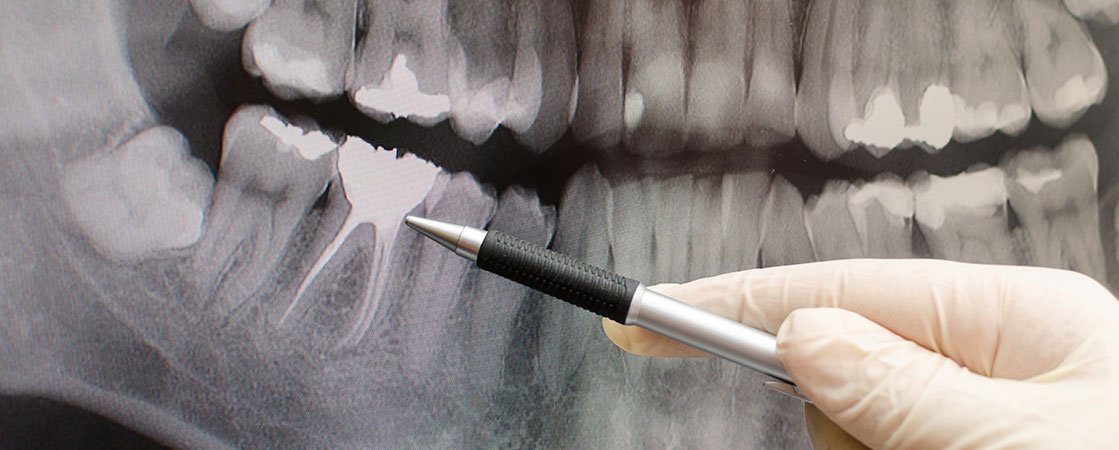
The Dental radiography is an important part of your dental care. It is the tool by which dentists can identify various dental issues through X-ray imaging.

The X-Rays provide the dentists and the patients with valuable information such as small cavities that are not visible to the naked eye and as a positive consequence significantly decreasing the cost and annoyance of fixing the problem. Also, the dentists can use X-rays to diagnose common problems such as decay, gum disease, root problems, abscesses, abnormal growths and different types of infection and even more serious issues related to the bones, such as cancerous tumours or cysts.

Some patients are understandably concerned about this kind of radiation. The good news is that the level of radiation emitted during dental X-rays is so low as to be considered negligible. Depending on where you live and what you do throughout your day, you may get more radiation through daily life than you do through a single mouth X-ray. However, cells can be damaged by many small doses that add up over time. That’s why experts say that X-rays should be used with caution and only when necessary.

Their frequency depends on the individual’s dental health, signs of dental problems, age, and risk for oral disease. In most cases, a new patient will require a full set of mouth X-rays so that the dentist can evaluate their oral health status and for future comparisons. Follow-up or existing patients may require X-rays to monitor their gum condition or chances of tooth decay.

In children, radiographs allow the dentist to see how their teeth and jawbones are developing.

If you are seeing a new dentist, make sure to provide him/her with copies of your existing X-Rays to avoid duplicating them. This also will help limit your exposure to radiation.

If you are pregnant, tell your dentist. During your pregnancy, you may need to have radiographs taken as part of your treatment plan for a dental disease that requires immediate attention. Use of the leaded apron and collar will protect you and your foetus from radiation exposure.

Often people are asking why X-rays cost so much. The X-ray machines are expensive. These are sophisticated and technologically advanced machines. Also, the software and computers to digitally process the x-rays have a relatively high cost.

To learn more about the benefits and safety of dental radiographs, talk with your dentist.

With early detection using dental X-Rays, you can get the treatment you need before problems have a chance to develop. They can save you from the pain, time and expense of treating them after they are getting worse.

Oral care for babies

babies oral care
The baby teeth are very important! They help a child to learn to chew and speak properly. They maintain the correct space in a child’s gums to allow the eruption of their permanent teeth.

Normally, a child has a full set of 20 baby teeth by the age of two to three years. The children first dental visit should be right after the eruption of the first tooth or by the child’s first birthday.

When new teeth break through their gums, babies are irritable. There are signs and symptoms as: frequent crying and crankiness, slight fever, reddened cheeks and drooling, appetite loss and upset stomach, diarrhoea, sucking or gnawing on toys, pulling the ear on the same side as the erupting tooth.

To help relieve the discomfort of teething, the Australian Dental Association gives some tips:

  • Washing your hands and then gently rubbing your baby’s gum with a clean finger.
  • Give your baby a teething ring or wet washcloth to bite.
  • Teething rings can be chilled in the refrigerator before use to help manage gum swelling and pain. Do not put teething rings in the freezer!
  • Give your baby non-sweetened rusks to chew on.
  • Ask your dentist or pharmacist for advice before using any pain reliever specifically created for babies and toddlers. Never give aspirin to a baby or young child.

Another thing you should consider in regarding baby’s oral health is thumb sucking. This is a natural reflex in babies and young children. Children who continue to suck their thumb or fingers after the permanent teeth have appeared risk developing crooked teeth. Also, speech defects may arise, especially with the “s” and “th” sounds. Encourage the child to give up thumb sucking and if necessary ask your dentist for advice if your child cannot stop thumb sucking.

As soon as your baby develops their first tooth, they are at risk of dental decay. Here are some advices to help in preventing this:

  • Avoid settling your baby to sleep overnight with a breastfeed or bottle of milk, sweetened flavoured milk, cordial, soft drink or fruit juice.
  • If your baby needs to suck on something to sleep, offer a dummy rather than a bottle.
  • Encourage your baby to learn to drink from a toddler cup from 12 months of age.
  • Before bed, gently wipe down baby’s teeth with a moistened cloth before putting them to sleep.
  • Avoid giving your baby or toddler frequent snacks – three meals and two snacks per day is ideal to meet dietary needs. Diet plays a significant role in the health of your child’s teeth. Your child should enjoy a variety of nutritious foods, especially foods rich in calcium and low in acids and sugars. Offer your child a diet high in fresh fruits and vegetables, wholegrain cereals, lean meats and dairy products. Limit sugary snacks such as lollies, fruit and muesli bars, biscuits, dried fruit, cordials, juices and soft drink.
  • Make sure you clean your child’s teeth morning and night.
  • Maintain a good oral hygiene by brushing and flossing teeth and having regular dental check-ups.

In order to brush your baby’s teeth, you may:

  • Once baby teeth appear, use a baby’s toothbrush with a small head and soft with rounded bristles. Replace the toothbrush regularly, every one to three months.
  • Up to 18 months, brush their teeth with plain water.
  • Special low fluoride toothpastes can be used around the age of 18 months. Just a very small amount.
  • Teach your child to spit out the toothpaste after brushing. But don’t rinse his mouth with lots of water. Leaving a bit of toothpaste residue on the teeth makes the toothpaste work better.
  • Have the toothpaste out of reach of the children because some of them like it too much and they can eat it.
  • Having your baby on your lap, facing away from you, helps you reach the teeth more easily. Brush with small, gentle circular movements, concentrating on the area where the teeth and gums meet.
  • If your baby doesn’t like having the teeth brushed and squirms away, try giving them their own toothbrush to hold. It is very probable that they will feel in charge. You can even let them to have a go by themselves. Of course, with your help.
  • If you can, let your baby watch you brushing your teeth as often as possible. The power of example!
  • You can seek guidance to your dentist or dental hygienist. They will be happy to help.

Starting with the age of two and a half, you can floss at least twice weekly in areas where the teeth are touching. Flossing helps remove bacteria from between teeth and keeps the gums healthy. Slide the floss between the teeth and gently work it up and down, against the surfaces of each tooth. After flossing, have your child rinse with water. And finally, brush your child’s teeth.

Try to make it as fun as possible, with songs, colours and play!

How to Brush and Floss Your Teeth

How To Brush Your Teeth

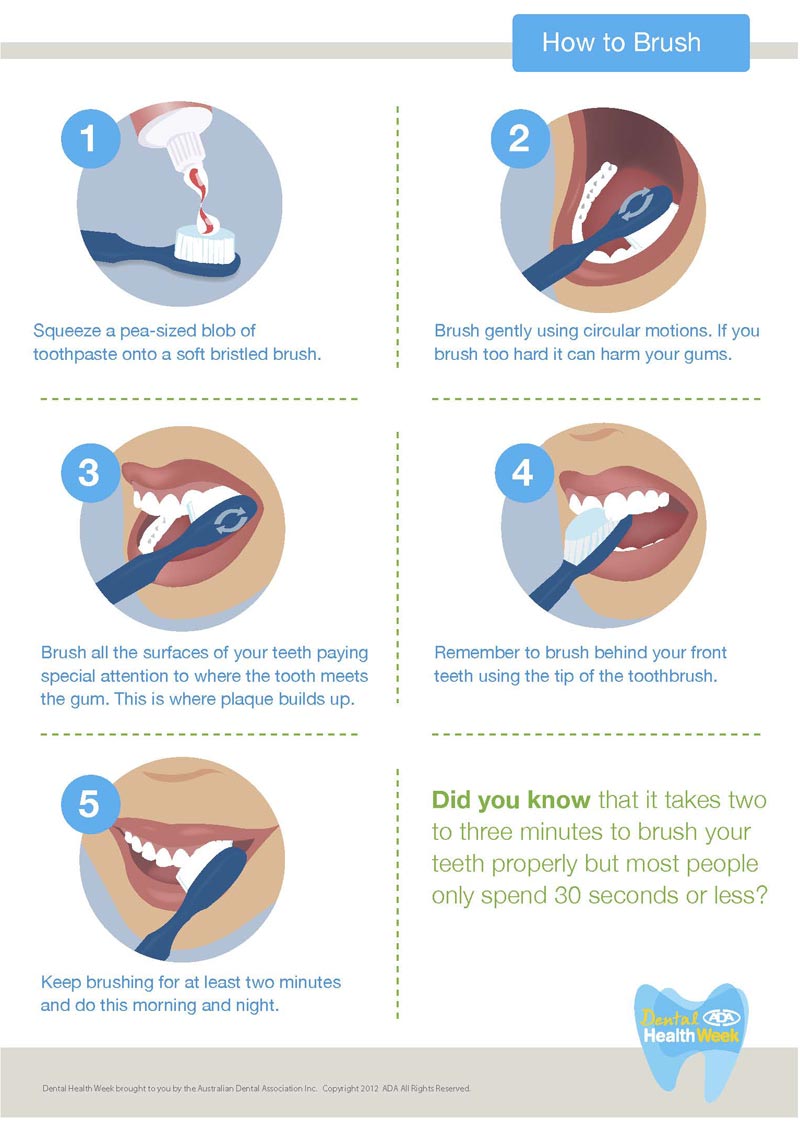
To properly brush your teeth, use small, circular motions, paying attention to the gum line, hard-to-reach back teeth and areas around fillings, crowns, implants or other restorations.

Place the toothbrush at a 45°angle along the gum line. Move the toothbrush in a small, circular motion, and repeat for each tooth.

Brush the inside surface of each tooth.

Brush the chewing surface (top) of each tooth.

Use tip of the brush to brush behind each tooth — front and back, top and bottom and up and down strokes.

For fresher breath, be sure to brush your tongue at least once a day.how to brush

How To Floss Your Teeth

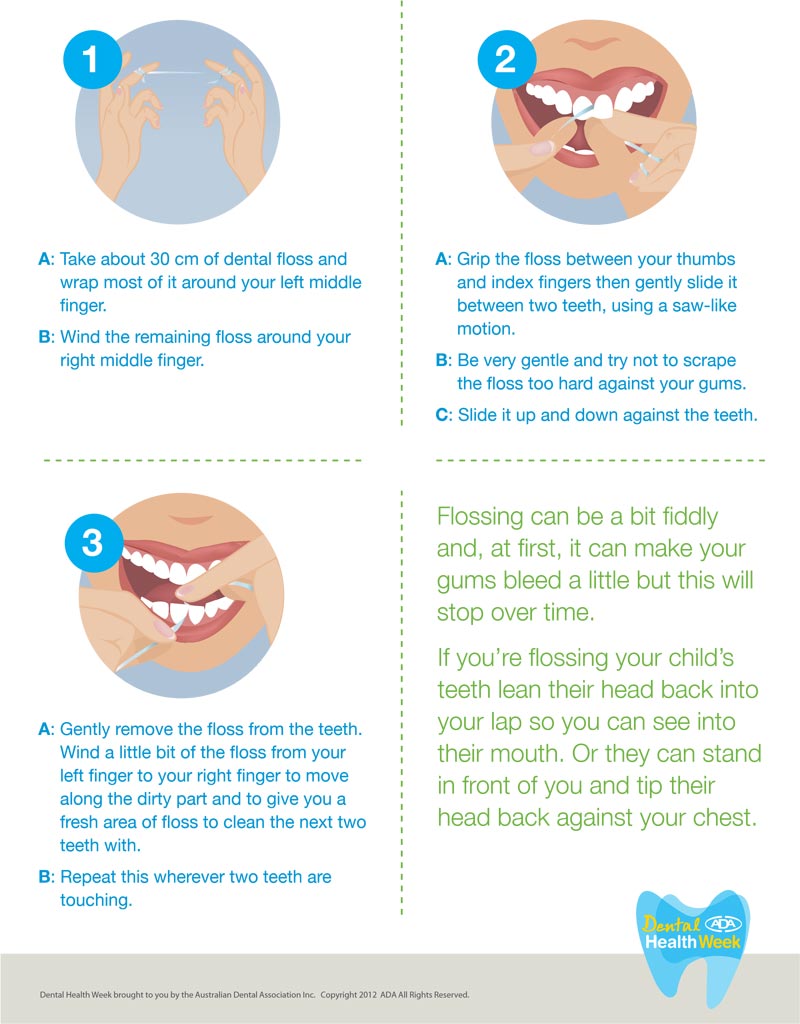
Pull approximately 30 centimetres of dental floss from the floss dispenser.

Wrap the ends of the floss around your index and middle fingers.

Hold the floss tightly around each tooth in a C shape; move the floss back and forth in a push-pull motion and up and down against the side of each tooth.

how to floss

Call Now, We're Available (02) 8021 5285 Book Online