Bulk Bill Your Child’s Dental Today!

Often children’s teeth and overall oral health can be neglected due to their age and presence of baby teeth. Yes, their baby teeth will fall out eventually, but they still need care and attention in the meantime. Healthy baby teeth will encourage health adult teeth. Also, teenagers whose adult teeth have already erupted require regular checkups to start their oral health journey off right. We know dentistry expenses can add up, particularly if you do not have private health cover. At Sydney’s Rainbow Dental our prices are very competitive, but there is another way you can reduce, and even eliminate, the dental costs for your children- the Medicare Child Dental Benefits Schedule.

What is the Medicare Child Dental Benefits Schedule?

Eligible families of children aged 2-17 years old can claim up to $1000 of dental services over two years. This is a fantastic scheme to help ensure the superior oral health of all Australian children and teenagers while taking the financial burden off parents. So why not take advantage of this Government funded benefit? We’ll Bulk Bill your child’s dental so you can all leave Rainbow Dental Practice with a smile. To check your eligibility for the Schedule, visit the Medicare website at www.humanservices.gov.au

What can I claim?

Most child dental services are claimable under the Medicare Schedule. The most common are:

  • Checkups
  • Clean
  • Fluoride
  • Fillings
  • Extractions
  • X-Rays
  • Root canal treatments

Our helpful dentists will discuss with you any restrictions to the Bulk Billing Scheme that may affect your child’s treatment.

dentist-2264144_1280

Child-friendly Dental near Rhodes

Creating an atmosphere that is nonthreatening, calm and enjoyable for children is our goal at Rainbow Dental. We want to foster a life-long, healthy relationship for your child with their dentist and educate both you and your child on Preventative Dental techniques. Our Dentists understand that children – and adults! – can often suffer from anxiety when checkups are due, so we’ll do our utmost to avoid any stress and use gentle dentistry interventions.

Young children can develop habits such as tongue thrusting and thumb sucking, which can in turn result in malformed teeth and alignment. Our children’s dentists can help resolve these issues and ensure your child’s teeth are developing normally. A general recommendation is for children from the age of 2 years old to come in for their first appointment – we’ll make it fun, relaxing and enjoyable. They’ll want to come back!

With Medicare’s $1000 Child Dental Schedule, making your child’s oral health a top priority is easy and affordable. Sydney’s Rainbow Dental Practice is ready to put your children on a path of strong, healthy teeth for life – and we’re right near Rhodes! Book an appointment today with our friendly and experienced dentistry team by calling 02 8021 5285.

We’re an easy 6 minute drive from Rhodes

There is free 30-minute parking available in front of our clinic. P6 paid parking is also located within 200m of the Practice.

When will my baby get his first tooth?

babytooth

Baby teeth or primary teeth are playing a very important role in a child’s life. They are vital for chewing and speech development and in maintaining the space for the adult teeth. For this reason, your child should be taught how to have a good dental hygiene from a very young age.

Normally, your children will have their first teeth around six months old. Sometimes maybe earlier as four months and as late as ten. No need to alarm if teething starts a little earlier or later. If you’re worried, see a dentist to make sure everything is as it should be. There are 20 baby teeth, ten at the top and ten at the bottom. Usually they erupt in pairs from the front of the mouth to the back. The bottom ones are arriving a couple of months prior to the top ones.

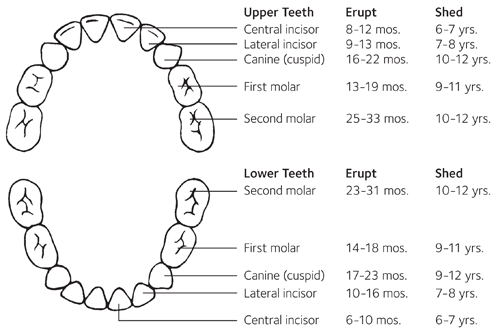
The ADA chart below illustrates the names of each tooth, at what age it is likely to erupt, and at what age they are then likely to be lost.

babytooth2

  • Lower central incisors, the bottom middle teeth, typically come in first. These little ones usually arrive around the same time.
  • Upper central incisors, the upper middle teeth, come next, usually between 8 and 12 months.
  • Upper lateral incisors, around 9 to 13 months you can see the upper teeth to the right and left of center.
  • Lower lateral incisors, the lower teeth to the right and left of center appear around 10 to 16 months. Now your baby can have the toothy smile.
  • Upper first molars – your child’s first molars, the wider teeth toward the back of the mouth, erupt on the top between about 13 and 19 months.
  • Lower first molars, the companion molars on the bottom emerge around 14 to 18 months.
  • Upper canines fill the gap between the incisors and first molars at 16 to 22 months.
  • Lower canines make their appearance around 17 to 23 months. Your child’s smile is the brightest.
  • The second molars, around 23 to 33 months, the final teeth, the rear molars on the bottom and top, emerge.

By age 3, most children have a full set of 20 baby teeth and can give you a brilliant smile. And by around age six a child will start losing them to make way for their adult teeth.

For your children first dental visit please contact us on 02 8021 5285

How To Brush Your Child’s Teeth

brush childs teeth

child has a full set of 20 baby teeth by the age of two to three years.

As soon as your baby develops their first tooth, they are at risk of dental decay. To prevent this, firstly you should make sure you clean your child’s teeth morning and night and maintain a good oral hygiene by brushing and flossing their teeth and having regular dental check-ups, apart from choosing a healthy diet and proper overall hygiene.

To brush your baby’s teeth, use a baby’s toothbrush with a small head and soft with rounded bristles. Replace the toothbrush regularly, in between one to three months. Having your baby on your lap, facing away from you, helps you reach the teeth more easily. Brush with small, gentle circular movements, concentrating on the area where the teeth and gums meet. If your baby doesn’t like having the teeth brushed and squirms away, try giving them their own toothbrush to hold. It is very probable that they will feel in charge. You can even let them to have a go by themselves. Of course, with your help. Up to 18 months, brush their teeth with plain water. Special fluoride-free toothpastes can be used around the age of 18 months. Just a very small amount.

Teach your child to spit out the toothpaste after brushing. But don’t rinse his mouth with lots of water. Leaving a bit of toothpaste residue on the teeth makes the toothpaste work better. Do not forget to put the toothpaste out of reach of the children because some of them like it too much and they can eat it.

If you can, let your baby watch you brushing your teeth as often as possible. The power of example! You also can seek guidance to your dentist or dental hygienist. They will be happy to help.

Toddlers should have their teeth brushed twice a day, ideally for two minutes at a time, in the morning after breakfast and in the evening before bed. Your toddler will need your attention during brushing.

Teach them how to brush. Don’t forget to get the right brush, with a long handle that allows you to reach around every tooth in your toddler mouth. Sometimes, you can apply the finger brushing. Finger toothbrushes slip onto your finger and have soft bristles at the tip. Buy a colourful toothbrush. You can find a toothbrush that lights up, plays music, or makes a noise after the job’s done. Whatever type of toothbrush you use, replace it every one to three months.

Put your child on a step stool in front of you. Face a mirror and brush his teeth with your hand over their hand. This way, they can watch you and learn how to brush. Work on one tooth at a time, and use a gentle back-and-forth motion across the chewing and inner surfaces, then switch to a circular motion along the sides, holding the brush at a 45-degree angle. On areas that don’t have teeth yet, lightly brush the gums, and don’t forget the tongue, which is a popular hangout for bacteria.

Regarding the toothpaste and mouthwash, it is better to stick only to water or fluoride-free toothpaste until your child can be trusted not to swallow it. After that, your child can start using a pea-sized amount of fluoridated toothpaste. When they are around two years old, you can show them how to rinse after brushing. You can also use a fluoride-free mouthwash, if the dentist or paediatrician gives you the ok.

Flossing is needed to be started as soon as two teeth grow in side by side. Starting with the age of two and a half, you can floss at least twice weekly in areas where the teeth are touching. Flossing helps remove bacteria from between teeth and keeps the gums healthy. You can use your regular floss or try one of those handheld plastic flossers shaped like a kid-friendly character.

Have your toddler on your lap, facing you. Floss their teeth as you would your own, using your index fingers and thumbs to guide floss gently in between the teeth. Carefully slide the floss up and down against the tooth surface and under the gum line, flossing each tooth with a clean section. Focus on the molars first and work your way from the back of the mouth to the front. You may let your little one have a go with the floss. After flossing, have your child rinse with water. And finally, brush your child’s teeth.

Try to make your children’s cleaning teeth a fun time! You may sing a song, tell a story or ask a nightly riddle during brushing.

Giving them a good hygiene and a proper health education is the foundation of a healthy and happy life!

Please feel free to contact our kids friendly dentist on 02 8021 5285 if you have any queries.

School Holidays And … A Visit To The Dentist

Taking advantage of Medicare Child Dental Benefits Scheme

child-dental-benefits

School holidays are approaching!

Try to benefit from this time of year and book your children in for their regular dental check-up or any other needed treatment, by using your private health dental benefits or the Medicare’s Child Dental Benefit Scheme.

Good oral health is an important “pillar” of a good overall health. A dental check-up will provide a great start to dental health for you and your children.

According to prof. David Manton, the Chair of the Australian Dental Association’s (ADA) Oral Health Committee, there are lots of evidences suggesting that the oral health of Australian children is not at the level that should be, having over 4 out of 10 children aged 5-10 with decay in their baby teeth; more than 3 out of 10 children aged 9-14 having decay in their permanent teeth and over 4 out of 10 children overall had moderate or abundant visible plaque on their teeth. With these, the Professor Manton is accentuating the need and the importance for a regular dental check-up.

In accordance with statistical studies, children under the age of 10 are best treated in the morning, when they are fresh and rested, rather than in the afternoon, when they might be tired after school and the treatment could be more stressful for them and their parents. Parents may have some concerns about taking the children out of school for their dental appointments. One of the best solutions is to arrange an appointment to see the dentist during school holiday periods.

The teenagers can be seen in the afternoons, because they are more relaxed at 2pm rather than 3.30pm or later. But they may still have school at that time of the day. Sometimes it is easier to remove them from school for the last one or two lessons than taking them out of school and returning after, especially if they may have a numb jaw after fillings or extraction treatments. Again, the best solution is to have them booked at the dentist during their school holidays.

Pre-booking your child for the next visit in 6 months for a regular check-up gives parents a greater flexibility in selecting the best times that suit their children’s ages and school requirements. Also, you could wisely use the benefits for dental treatments from your health private funds.

If you have not known, maybe you should consider to check if your child is eligible for the Australian Government’s Child Dental Benefits Schedule (CDBS) and having basic dental treatments covered by Medicare. This service is designed to provide financial support for children between the ages 2-17 years of age, allocating $1000 every two years for basic dental services, per child. Prior to book an appointment at the dentist, check with Medicare to see if they are eligible. Under this scheme, children can receive treatment from either a public or private dental clinic. You should let the dentist know, when you are booking, that you are looking to take advantage of this scheme. At the time of appointment, you will need to have a current Medicare card and fill in a “CDBS bulk billing consent form”.

Basic dental services covered by the scheme are: examinations, X-Rays, cleaning, fissure sealing, fillings, root canal treatment, some extractions.

Please note that services including orthodontic or cosmetic dental work are not covered by the Child Dental Benefits Schedule.

For more information on eligibility please call us on 02 8021 5285 we will check your children eligibility and let you know.

Oral care for babies

babies oral care
The baby teeth are very important! They help a child to learn to chew and speak properly. They maintain the correct space in a child’s gums to allow the eruption of their permanent teeth.

Normally, a child has a full set of 20 baby teeth by the age of two to three years. The children first dental visit should be right after the eruption of the first tooth or by the child’s first birthday.

When new teeth break through their gums, babies are irritable. There are signs and symptoms as: frequent crying and crankiness, slight fever, reddened cheeks and drooling, appetite loss and upset stomach, diarrhoea, sucking or gnawing on toys, pulling the ear on the same side as the erupting tooth.

To help relieve the discomfort of teething, the Australian Dental Association gives some tips:

  • Washing your hands and then gently rubbing your baby’s gum with a clean finger.
  • Give your baby a teething ring or wet washcloth to bite.
  • Teething rings can be chilled in the refrigerator before use to help manage gum swelling and pain. Do not put teething rings in the freezer!
  • Give your baby non-sweetened rusks to chew on.
  • Ask your dentist or pharmacist for advice before using any pain reliever specifically created for babies and toddlers. Never give aspirin to a baby or young child.

Another thing you should consider in regarding baby’s oral health is thumb sucking. This is a natural reflex in babies and young children. Children who continue to suck their thumb or fingers after the permanent teeth have appeared risk developing crooked teeth. Also, speech defects may arise, especially with the “s” and “th” sounds. Encourage the child to give up thumb sucking and if necessary ask your dentist for advice if your child cannot stop thumb sucking.

As soon as your baby develops their first tooth, they are at risk of dental decay. Here are some advices to help in preventing this:

  • Avoid settling your baby to sleep overnight with a breastfeed or bottle of milk, sweetened flavoured milk, cordial, soft drink or fruit juice.
  • If your baby needs to suck on something to sleep, offer a dummy rather than a bottle.
  • Encourage your baby to learn to drink from a toddler cup from 12 months of age.
  • Before bed, gently wipe down baby’s teeth with a moistened cloth before putting them to sleep.
  • Avoid giving your baby or toddler frequent snacks – three meals and two snacks per day is ideal to meet dietary needs. Diet plays a significant role in the health of your child’s teeth. Your child should enjoy a variety of nutritious foods, especially foods rich in calcium and low in acids and sugars. Offer your child a diet high in fresh fruits and vegetables, wholegrain cereals, lean meats and dairy products. Limit sugary snacks such as lollies, fruit and muesli bars, biscuits, dried fruit, cordials, juices and soft drink.
  • Make sure you clean your child’s teeth morning and night.
  • Maintain a good oral hygiene by brushing and flossing teeth and having regular dental check-ups.

In order to brush your baby’s teeth, you may:

  • Once baby teeth appear, use a baby’s toothbrush with a small head and soft with rounded bristles. Replace the toothbrush regularly, every one to three months.
  • Up to 18 months, brush their teeth with plain water.
  • Special low fluoride toothpastes can be used around the age of 18 months. Just a very small amount.
  • Teach your child to spit out the toothpaste after brushing. But don’t rinse his mouth with lots of water. Leaving a bit of toothpaste residue on the teeth makes the toothpaste work better.
  • Have the toothpaste out of reach of the children because some of them like it too much and they can eat it.
  • Having your baby on your lap, facing away from you, helps you reach the teeth more easily. Brush with small, gentle circular movements, concentrating on the area where the teeth and gums meet.
  • If your baby doesn’t like having the teeth brushed and squirms away, try giving them their own toothbrush to hold. It is very probable that they will feel in charge. You can even let them to have a go by themselves. Of course, with your help.
  • If you can, let your baby watch you brushing your teeth as often as possible. The power of example!
  • You can seek guidance to your dentist or dental hygienist. They will be happy to help.

Starting with the age of two and a half, you can floss at least twice weekly in areas where the teeth are touching. Flossing helps remove bacteria from between teeth and keeps the gums healthy. Slide the floss between the teeth and gently work it up and down, against the surfaces of each tooth. After flossing, have your child rinse with water. And finally, brush your child’s teeth.

Try to make it as fun as possible, with songs, colours and play!

Consequences of Poor Childhood Dental Care during Entire Life Span

Oral health is an important aspect of overall health of individuals. Our mouth is the gateway to our body. Food as well as all other things in the mouth can travel to our systems including bacteria and infections.

Childhood Dental CareWe all know that mind rules the body. The state of body affects the way we think, and the frame of mind you are in affects the way the body functions. There is a mind and body connection both ways.

It is also true for mouth and body. There is a connection between mouth and body. If one is not well, the other is affected.

If something is wrong in your mouth your body does not behave normally, similarly when something is wrong in the body, your mouth will show it.

  1. Respiratory diseases

Gum disease is the inflammation of the gums called gingivitis. If it is not treated there is a risk of teeth loss and it may lead to increased risk of respiratory ailments, as the bacteria in plaque can travel from mouth to respiratory system, and onto lungs, causing infections or aggravating existing lung conditions.

  1. Heartproblems/stroke

People suffering from infections of the gums, have increased risk of heart disease as the bacteria travels to blood vessels and enter blood stream. These bacteria contain a protein which narrows the arteries, risking heart attack and stroke.

  1. Diabetes

There is a link between gum diseases and diabetes. Diabetes becomes more unyielding if you have a mouth infection, because it disrupts the blood sugar levels to a certain extent. Untreated gingivitis leads to complications for diabetic patients.

  1. Premature delivery/Low birth weight babies

Studies are going on to examine the link between women with poor dental health and premature births, as well as low birth weight babies. It is suspected that women who have oral issues prior to pregnancy or currently are at a higher risk of delivering pre term babies and delivering low birth weight babies.

  1. Dementia

The bacteria responsible for gum disease travel to the brain through blood stream and causes dementia.

  1. Social life

Oral health impacts social lives too. Good oral hygiene improves appearance, self-esteem and hence quality of life. Poor oral health induces bad breath a social deterrent which reduces number of social relationships and risks deterioration of social life.

  1. Academic/professional life

Imperfect oral health causes disruption of academic and career or in professional life, resulting in emotional/social problems.

  1. Weak immune system

If the immune system is weak; the individual will get more infections in the mouth, as the immune system protects our body from illness and infections.

  1. Drugs and medicines

Many drugs make the moth dry which increases the risk of dental decay and yeast infections.

The mouth acts as an indicator for other diseases in your body of which you may not be aware. By working with dentist we may be able to prevent or diminish the progression of harmful diseases. Sometimes the dentist can tell you about the disease and refer you to a specialist.

It is found that the major factors that are responsible for causing oral health problems are also considered risk factors for other diseases. For example, sugar, which is considered unhealthy for weight gain, heart diseases and diabetes, is equally harmful for teeth. Drugs and narcotics, which are harmful for heart, lung and body in general, are harmful for teeth also. Alcohol is bad for oral hygiene as well as for the liver.

Oral hygiene is important not only for the teeth but for also for the entire body as the health of one affects the health of the other.

Tips to Prepare Children for Lifelong Dental Care

slider1Dental care starts for your baby before the actual teeth appear. The expectant and nursing mother should take care and be informed about what medications they are taking, because certain antibiotics do affect teeth coloration even before they appear!

Whenever you are advised to take an antibiotic, do not hesitate to ask your physician about its side effects and whether it will harm the unborn or the nursing baby in any way.

Learning by Imitation

We all know that babies learn from imitation and repetition. The best way to teach a child to take care of his/her teeth is to do it yourself. As adults, we should follow a healthy dental hygiene routine ourselves. When children see their parents following a healthy dental care routine, they follow it unconsciously.

The Daily Routine

The cleaning of the teeth starts after a few days of birth. Slowly it should become part of the daily routine.

Wipe the mouth and gums of the newborn with a clean gauze or washcloth. This will keep the bacteria away from the mouth. Tooth decay can occur as soon as teeth appear. The sugars in the milk and juices have a tendency to stick to the base of the teeth and invite bacteria to feed on these. Keeping the gums clean is a good way to start dental hygiene for babies.

Begin brushing your child’s teeth as soon as they appear. Make it fun thing. Use colorful smalltoothbrush for babies, and nice smelling toothpastes that are especially made for infants and toddlers. The whole event should be done lightly in a pleasant manner. The toothpaste need not be more than the size of a rice grain, a thin film covering the brush.

Brush children’s teeth twice a day. Children below 3 to 4 years of age should be supervised to minimize swallowing of toothpaste. Do not allow the toddler to dispense the toothpaste from the tube. Adults should dispense toothpaste. It need not be more than a pea sized drop.

Usually after your child is 7 or 8 years, he will have learned to dispense very small drop of toothpaste and brush his teeth in front and back of the gums. Once you are satisfied that your child is able to dispense small amount of toothpaste and is able to brush his teeth on his own, let him follow the routine of brushing teeth twice a day.

Remember that praise goes a long way. Praise encourages the child to follow your instructions better.

Dental Visits

The best way to familiarize children with the atmosphere at the dentist is to take him with you when you visit the dentist for routine checkup. This will prepare him for his own visits.

As soon as the first tooth appears, it is time to schedule a visit to the dentist. The first visit  may be between 6 months to one year after the baby’s birth. It should not be later than your child’s first birthday.

It helps if you talk about the visit before you actually go there, to prepare the child about what to expect.

The first visit is mainly to familiarize the infant with the dentist and the surroundings. The first visit may be scheduled in the morning when the child is rested and not hungry,to elicit more cooperation from him.

Do not show your anxiety if you have any reservations, or fears about the dental care visits. Keep them to yourself. Refrain from discussing them in front of your child. Children can sense feelings and emotions of adults and make them their own.

Do not bribe your child for the visit. Bribing creates the impression of something dreadful or unpleasant.

Do not threaten your child with the dental visit. It will create dread and aversion for the visits to the dentist.

It is important to establish good dental hygiene routine for all in the family including babies and children. Once good habits are formed, it will stop any dental problems get out of hand, saving time, money and pain and distress when children are growing up.

Questions to ask your orthodontist about your child’s dental treatment

Questions to ask your orthodontistOrthodontics is a branch of dentistry which concerns itself with the diagnosis and correction of irregularities of teeth.

Some children are born with teeth which have some kind of malformation resulting in bad bite, or distortion of smile and face. Some children develop the problem because of cavities or other dental issues. After the baby teeth fall off these irregularities become noticeable, and parents have to consider options to correct them.

Which abnormalities can be corrected by orthodontics?

Orthodontic treatment can correct the following abnormalities of teeth which usually result in poor smile, and poor health as a result of poor oral hygiene.

  • Bad bite or malocclusion where teeth are misaligned
  • Crooked teeth
  • Overcrowding of teeth
  • Too much spacing between teeth

Here are a few questions the parent should ask before they start orthodontic treatment for their child.

  1. Who decides whether my child needs to go for orthodontic treatment?

It can be your dentist or a friend or your child’s teacher. It can be parents who feel the need to see an orthodontic expert.

  1. What does orthodontic process involve?

Before any treatment starts, the orthodontist will first take a panoramic photographic image of the child’s teeth. Based on the analysis of the photographs, the orthodontist will decide on the course of treatment. The parents will be called for a meeting and the phases of the treatment, the cost and the time it will take will be discussed. After the agreement of the parents and the child the doctor will begin the treatment.

  1. Does age matter for orthodontic treatment?

Now, the treatment can begin as soon as the child’s 7th year. The doctor can foresee the malocclusion and crowding of teeth well in advance before they appear and can begin treatment to straighten the path of the teeth. As such there is no limit as to when to begin the treatment but your doctor is the best judge to decide on when to begin.

  1. How much the treatment will cost?

The cost depends on how much work is needed. There are vast individual differences in the needs of children for dental work and the cost will be decided by discussing each phase of the treatment with parents.

  1. Does the orthodontic treatment produce permanent result?

No permanent guarantee can be given after the treatment as the teeth movement continues throughout one’s life.

  1. How long the treatment will take?

The time the treatment takes depends on the amount of work needed to correct the anomaly of teeth in the child. More work involved will take more time.

  1. How many teeth will be extracted during the treatment?

The number of teeth to be extracted during the treatment depends on how much space is needed for the correction of protruding or overcrowded teeth.

  1. How often one need to bring in one’s child for appointments?

The appointments depend on type of work that is going on. Initially the appointments may be closer together, but as the treatment advances, the appointments will be distant from each other. After the initial treatment the appointments usually falls once in three to four weeks.

  1. Does the child need to be accompanied by the parent for all appointments?

The parent can attend the whole session of the treatment if they choose to. But the child can be dropped for the appointment and can be picked up at appointed time.

  1. Will my child miss school?

It is not always possible to schedule the appointments after school, but as far as possible the doctor will try to accommodate your child when school is not on.

  1. Can the child attend school after the appointment?

Usually the child can attend school after the appointment but when the session is very long or intensive, then the doctor will inform the parent in advance and the appointment will be scheduled after school so that the child goes home after treatment.

  1. Will the child be hurt by braces?

Usually braces create discomfort and soreness in the gums  after they are being tightened. But this is not very painful. Whenever braces hurt too much, you should ask to see the doctor.After the third or fourth day the child will get used to braces and will get more comfortable.

  1. Can my child participate in normal sports?

The child can surely take part in the chosen sport with the mouthguard.

  1. What food restrictions will be there during the treatment?

Yes there will be diet restrictions. Hard foods like nuts, sticky foods like candies and ice cubes may damage orthodontic appliances, and therefore should not be taken during the entire treatment. The foods to be avoided are listed and will be given to you when you begin the treatment.

  1. Whom do I call in an emergency like broken braces?

You must call the office of your orthodontist in an emergency when anything goes wrong with the braces, or braces hurt too much or the child develops ulcers and so on.

This is just a list of probable questions. It is best to ask questions and clear doubts before you begin your child’s orthodontic treatment since the treatment is long and expensive and it is better to be well informed about what you are stepping into before you begin.

Oral Hygiene for Kids Infographic

Nothing is as special as your child’s happy, healthy smile. Learn how you can care for your child’s teeth.

When will the baby’s teeth come in?
Most children’s baby teeth — also known as primary teeth, deciduous teeth, or milk teeth — emerge in a certain order. Here’s what you’re likely to see as your child transitions from gums to pearly whites.

Dental-Hygiene-for-Kids

Call Now, We're Available (02) 8021 5285 Book Online